
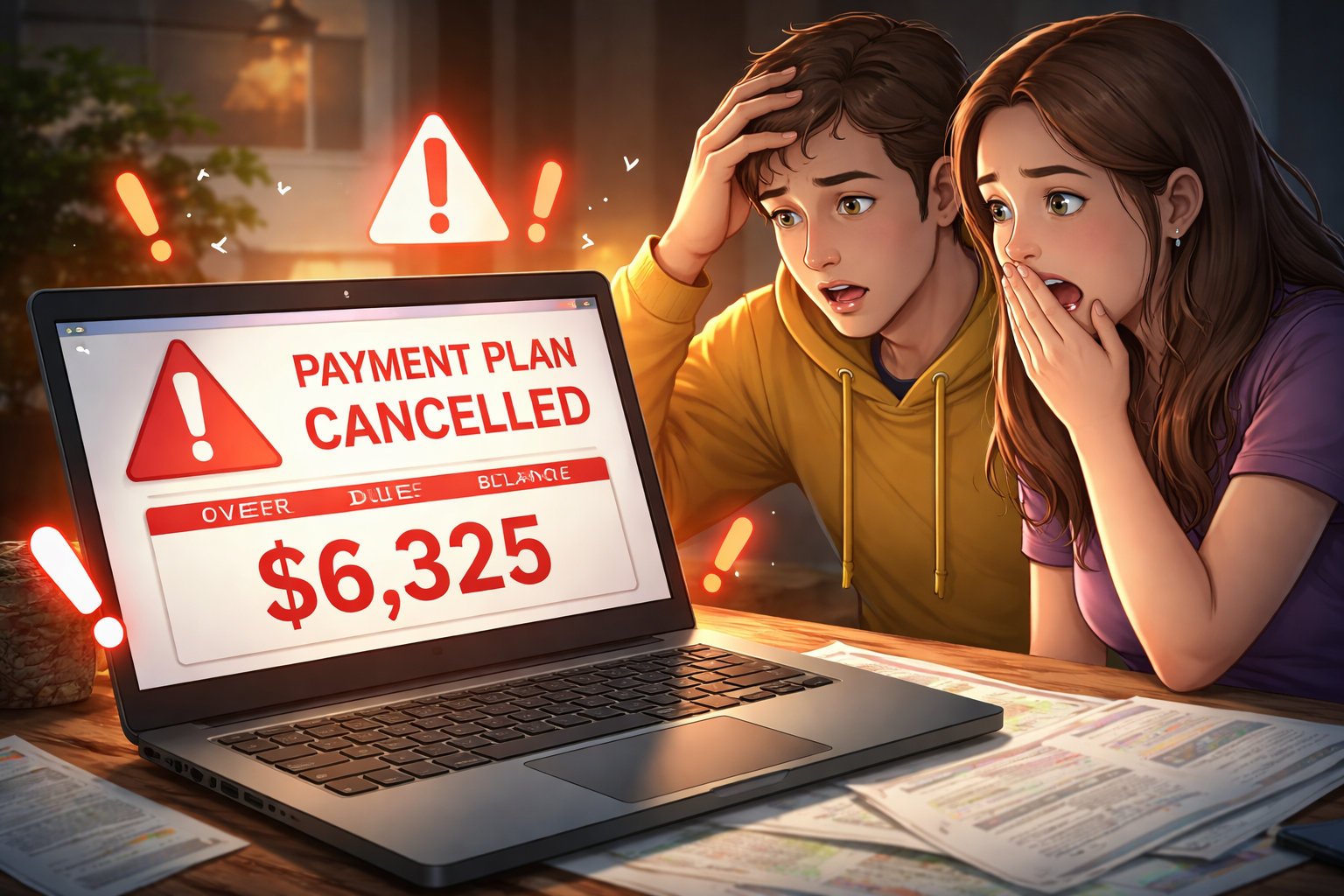
Tuition Payment Plan Cancelled Automatically After Missed Installment was the first thing that came to mind when I saw the portal screen change overnight. The monthly amount I had been watching was gone. In its place was a much bigger number, a tighter due date, and language that made it sound like the school had already moved on from the payment plan entirely.
There was no dramatic call. No one from the school explained what had changed in plain English. The account just looked different. Registration was suddenly at risk, the balance no longer looked manageable, and the system acted like the agreement had already ended before I fully understood what triggered it. That is what makes this situation dangerous: the account may move from manageable installment status to enforcement status faster than most students or parents expect.
If you want the broader framework first, this guide explains how college billing problems usually start, spread, and become larger account issues:
What changed the moment the plan disappeared
When Tuition Payment Plan Cancelled Automatically After Missed Installment happens, the school’s system usually does not treat it as a small delay. It treats it as a failed structured arrangement. That distinction matters. A missed one-time payment may be handled as a temporary delinquency, but a failed payment plan often changes the account at a deeper level.
The plan is not only a convenience feature. It is often coded as a standing agreement that allowed the school to postpone full enforcement while scheduled installments were being made. Once that agreement is broken, the account may be recalculated as if the deferred flexibility no longer exists. In practice, that means the system can convert the remaining installment balance into an immediately collectible tuition balance.
- The remaining scheduled installments may disappear
- The unpaid amount may be accelerated into one larger due balance
- Late fee logic may activate
- Registration, transcript, or enrollment restrictions may become eligible
- Collections review may move closer even if the missed amount looked small at first
That is why Tuition Payment Plan Cancelled Automatically After Missed Installment feels disproportionate to many families. The issue is not only the missed installment itself. The issue is that the system may now view the entire account as unstable.
Why this happens without much warning
Many schools rely on third-party payment plan vendors, bursar platforms, or automated student account systems. Those systems usually do not wait for a staff member to personally decide whether your situation deserves flexibility. They run on timing rules, status codes, retry windows, and overdue logic.
A very common sequence looks like this:
- An installment is due on a fixed date
- The bank draft fails, the card declines, or the payment is not completed
- A retry attempt may occur, but not always
- A short grace window may expire
- The payment plan status changes from active to cancelled, inactive, or defaulted
- The account ledger updates and the unpaid future installments collapse into a current balance
This is one reason Tuition Payment Plan Cancelled Automatically After Missed Installment can seem sudden. The borrower or parent may think the matter is still limited to one missed monthly amount. The billing system may already be treating the agreement as broken in full.
If you also suspect a posting or timing issue, this related page helps explain why balances sometimes do not reflect payments the way families expect:
How the school usually sees it internally
From the school’s side, a payment plan is often not viewed emotionally at all. It is a risk management tool. The school allowed the account to stay open under structured payment conditions. When those conditions are not met, the account may be reclassified.
That reclassification can affect several internal questions:
- Should the account remain eligible for future registration?
- Should the student keep access to class enrollment changes?
- Should the account be marked for hold review?
- Should staff still allow manual flexibility or has the account become higher risk?
- Should the account be escalated toward collections preparation?
This is why families often hear “the system cancelled it” instead of getting a personalized explanation. In many schools, staff are looking at a status that was already changed by policy settings or vendor rules.
The most common account paths after cancellation
How to tell which path you are in
Do not guess based on one message or one screen. Check the actual account indicators. When Tuition Payment Plan Cancelled Automatically After Missed Installment happens, you want to identify whether the issue is still reversible or already spreading into other account controls.
- Does the portal still show any option to reactivate or re-enroll in a plan?
- Has the due amount increased to the full remaining term balance?
- Have new late fees appeared?
- Can the student still register, add classes, or modify enrollment?
- Does the account show a hold, restriction, or delinquency code?
- Has the balance been sent to a different office or external servicer?
The fastest way to lose time is to focus only on the missed installment and ignore the account status changes that followed it.
What students and parents should do immediately
If Tuition Payment Plan Cancelled Automatically After Missed Installment just happened, act like the account is on a clock. Even if no collections letter exists yet, internal batch updates may still be coming.
- Log in and screenshot the current balance, due date, and any hold notices
- Check whether the cancellation happened after a failed auto-pay, expired card, bank rejection, or missed manual payment
- Call the bursar or student accounts office and ask whether reinstatement is still possible
- Ask whether the account is already coded for registration block or escalation
- Confirm whether any payment you make now will restore the plan or only reduce the accelerated balance
- Request written confirmation of whatever option they offer
Many families make the mistake of paying first and asking questions later. Sometimes that works. Sometimes it does not. If the system has already accelerated the balance, a partial payment may not restore good standing by itself. You need to know whether the school is offering reinstatement, replacement, or simple damage control.
Detailed situation splits that change the right response
If your concern is that the account may now move toward collections, read this before waiting too long:
Mistakes that usually make the outcome worse
- Assuming the school will automatically retry the missed installment
- Assuming a partial payment will automatically restore the old plan
- Waiting for a paper letter before taking the portal changes seriously
- Calling without checking whether a hold, fee, or acceleration has already been applied
- Discussing only the missed monthly amount instead of the full account status
- Ignoring how close registration, transcript release, or graduation timelines are
Tuition Payment Plan Cancelled Automatically After Missed Installment often becomes more expensive because families respond to the original missed payment while the account is already in a different stage. That mismatch causes delay.
What rights and practical leverage families still have
This is not a guarantee of any specific outcome, but students and parents can still ask clear, reasonable questions that force the school to explain the situation more precisely.
- Ask for the exact reason the plan was cancelled
- Ask the exact date and event that triggered cancellation
- Ask whether reinstatement is permitted under written policy
- Ask whether late fees can be reviewed if the failure was technical or corrected quickly
- Ask which restriction codes are now on the account
- Ask what payment amount or action would actually restore good standing
The goal is not to argue in the abstract. The goal is to force the account into a clear operational answer.
FAQ
Can Tuition Payment Plan Cancelled Automatically After Missed Installment be reversed?
Sometimes, yes. But usually only within a short period and only if the school still considers the account recoverable under policy.
Will the student be dropped from classes right away?
Not always. Some schools apply holds first, while others tie continued enrollment to account status more tightly. You need to confirm your school’s immediate enforcement step.
Does making the missed payment alone fix everything?
Not necessarily. Once Tuition Payment Plan Cancelled Automatically After Missed Installment has triggered acceleration, a payment may reduce the balance without restoring the plan terms.
Why did the balance get so much larger?
Because the remaining scheduled installments may have been combined into a current due balance once the agreement failed.
Can the school send the account to collections over this?
If the balance remains unpaid long enough, yes. A cancelled plan can remove the protection that the installment arrangement was giving you.
Key Takeaways
- Tuition Payment Plan Cancelled Automatically After Missed Installment is usually treated as a failed agreement, not a minor delay
- The account may be accelerated into a full current balance
- Registration, transcript, and enrollment problems may follow quickly
- Families need to verify reinstatement options, not assume them
- Portal changes matter even when no one has called yet
- Fast action is most effective before holds and collections routing deepen
Recommended Reading
If the cancellation has already started affecting registration or access, this next guide is the best follow-up:
For one official reference point on federal student aid information and school-related financial processes, see
StudentAid.gov.
Tuition Payment Plan Cancelled Automatically After Missed Installment is one of those account changes that looks administrative on the screen but can become academic, financial, and timing-related very quickly. A family may think they are dealing with one missed monthly payment when the school is already treating the account as fully unstable.
If this is happening now, log in, document the balance, confirm the exact account status, and contact the billing office before the next processing cycle changes the account again. Do not wait for the situation to explain itself. By the time it becomes obvious, the school may already be enforcing the next stage.