
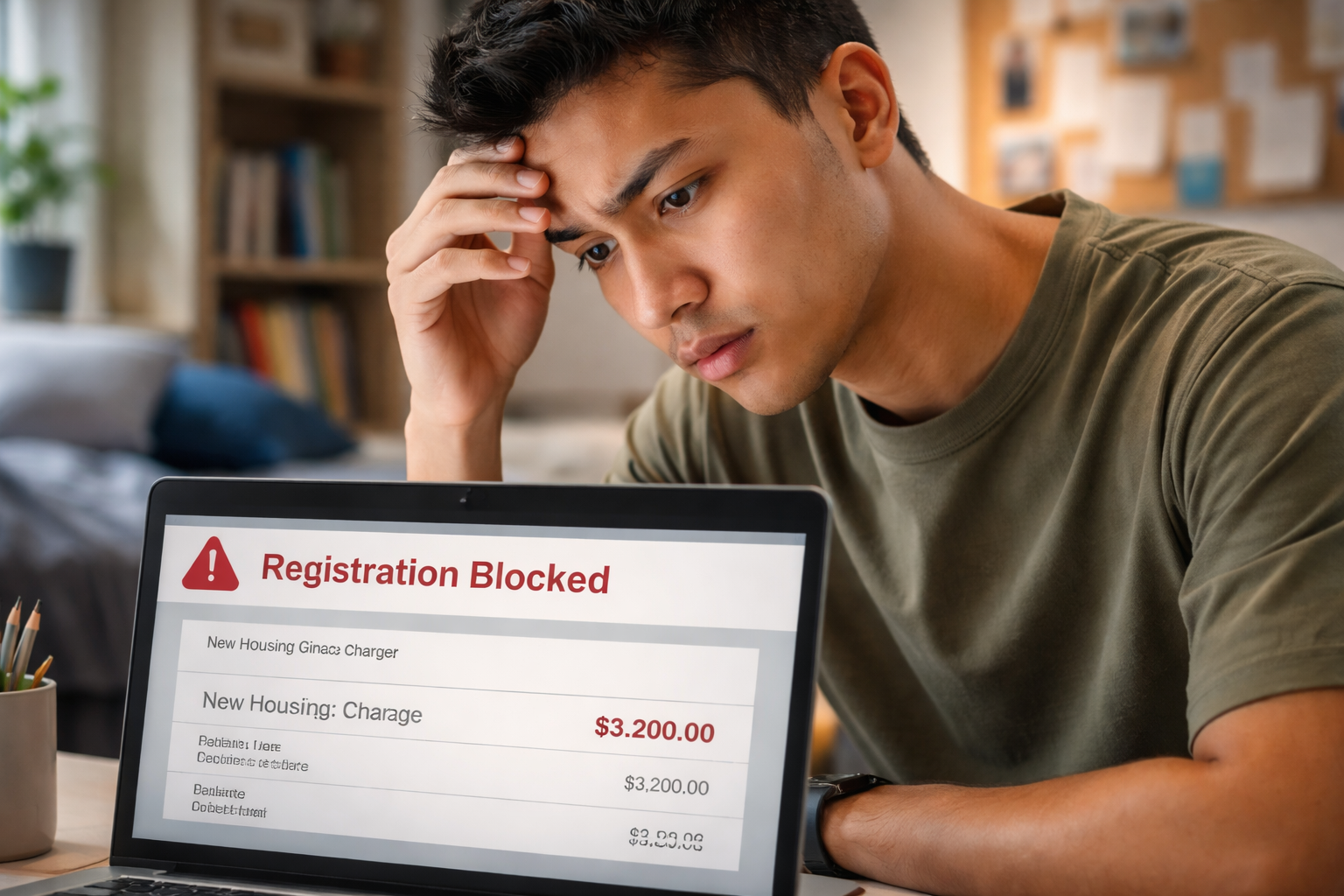
Registration blocked after housing charge posted.
If you are reading this, there is a high chance you are looking at your college portal right now. The class search works. Your registration window technically shows as open. But the final step — the button that actually registers you — refuses to move forward.
You refresh the page. Nothing changes.
You open your student account and scan for anything obvious: missed tuition, late fees, warning notices. Instead, you see only one new thing — a housing charge that was not there yesterday. Tuition looks the same. Your balance does not clearly say “past due.” The housing charge is the only difference.
If that description matches what is on your screen, stop guessing. This article is about your exact situation.
Registration blocked after housing charge posted is not rare. It is not a glitch. It is not a punishment. It is a predictable result of how U.S. colleges design their billing and registration systems — and it is usually fixable much faster than students expect once the right steps are taken.
The problem is not that students do not pay. The problem is that housing charges trigger a different set of rules than tuition, and most colleges never explain those rules clearly.
This overview explains the different billing-related holds colleges use and how they label them internally.
Immediate self-check: confirm this is exactly your case
Before going further, check yourself against this list. This article applies to you if:
- You were able to register recently or expected to register today
- Your registration button is visible but blocked or disabled
- A housing charge appeared very recently
- Your account does not clearly say “overdue” or “past due”
- You did not receive a clear warning email beforehand
If all of these are true, your registration was blocked by housing-related billing logic.
This matters because the solution for a housing-triggered block is different from the solution for a missed tuition payment.
Why housing charges are treated more aggressively than tuition
Registration blocked after housing charge posted happens because housing is not treated as a simple fee.
Tuition is predictable. It is the same amount for every enrolled student in a given program. Housing is contractual and physical. When housing is assigned, the college commits an actual resource: a room, utilities, maintenance, staff, and often food service.
Once that resource is reserved, it cannot easily be reassigned.
From the college’s risk perspective, housing creates exposure in a way tuition does not. That is why billing systems are often configured so that housing charges immediately affect registration eligibility.
When the housing charge posts, the system does not ask whether you plan to pay. It does not check whether aid is pending. It simply reassesses risk and applies a block if the account no longer meets its internal clearance rules.
What “posted” really means inside college billing systems
A major source of confusion in registration blocked after housing charge posted cases is the word “posted.”
Posted does not mean overdue. It does not mean final. It means the housing office has transmitted the charge to the central student account ledger.
The moment that transmission occurs, the billing system recalculates your account status.
This recalculation can happen:
- Before your registration window opens
- In the middle of an active registration session
- Just before add/drop deadlines
The system does not wait to notify you. It blocks first.
This breakdown shows how housing, meal plans, and other high-impact charges are prioritized.
What is happening behind the scenes right now
When registration blocked after housing charge posted appears, this is the typical internal sequence:
- The housing office posts the charge
- The student account system recalculates exposure
- Your registration clearance flag is reset silently
- No notification is required to apply the block
No one is manually reviewing your account at this stage. The system is acting automatically.
Why waiting usually makes nothing better
Many students assume the system will “catch up” on its own. In housing cases, that almost never happens.
Registration blocked after housing charge posted usually stays in place until someone in billing manually reviews or overrides the hold.
Waiting one day rarely changes anything. Waiting several days can cost you classes.
Your rights as a student (and when parents can help)
If registration blocked after housing charge posted is preventing enrollment, you are entitled to clear information.
You can ask billing:
- Which specific charge triggered the block
- Whether the hold is automated or manual
- What exact action removes it
You are not required to wait for the next billing cycle.
If deadlines are close, a parent can often confirm information with billing, even if actual account changes still require student authorization.
Exactly what to say when you contact billing
When you call or email billing, wording matters.
Use clear, system-aware language:
- “Can you confirm whether the housing charge is marked as registration-impacting?”
- “Is this an automated hold that can be manually reviewed today?”
- “What specific condition clears this hold immediately?”
These questions signal that you understand how the system works.
Common mistakes that delay resolution
When registration blocked after housing charge posted happens, these mistakes cost time:
- Calling the housing office instead of billing
- Making random partial payments
- Waiting without confirming next steps
Wrong office equals lost days.
Key Takeaways
- Registration blocked after housing charge posted is system-driven
- Housing charges reset registration clearance automatically
- Manual billing review resolves most cases quickly
If your screen matches what you read here, do not wait.
Call student accounts today, ask for review, and remove the hold before it costs you classes.