
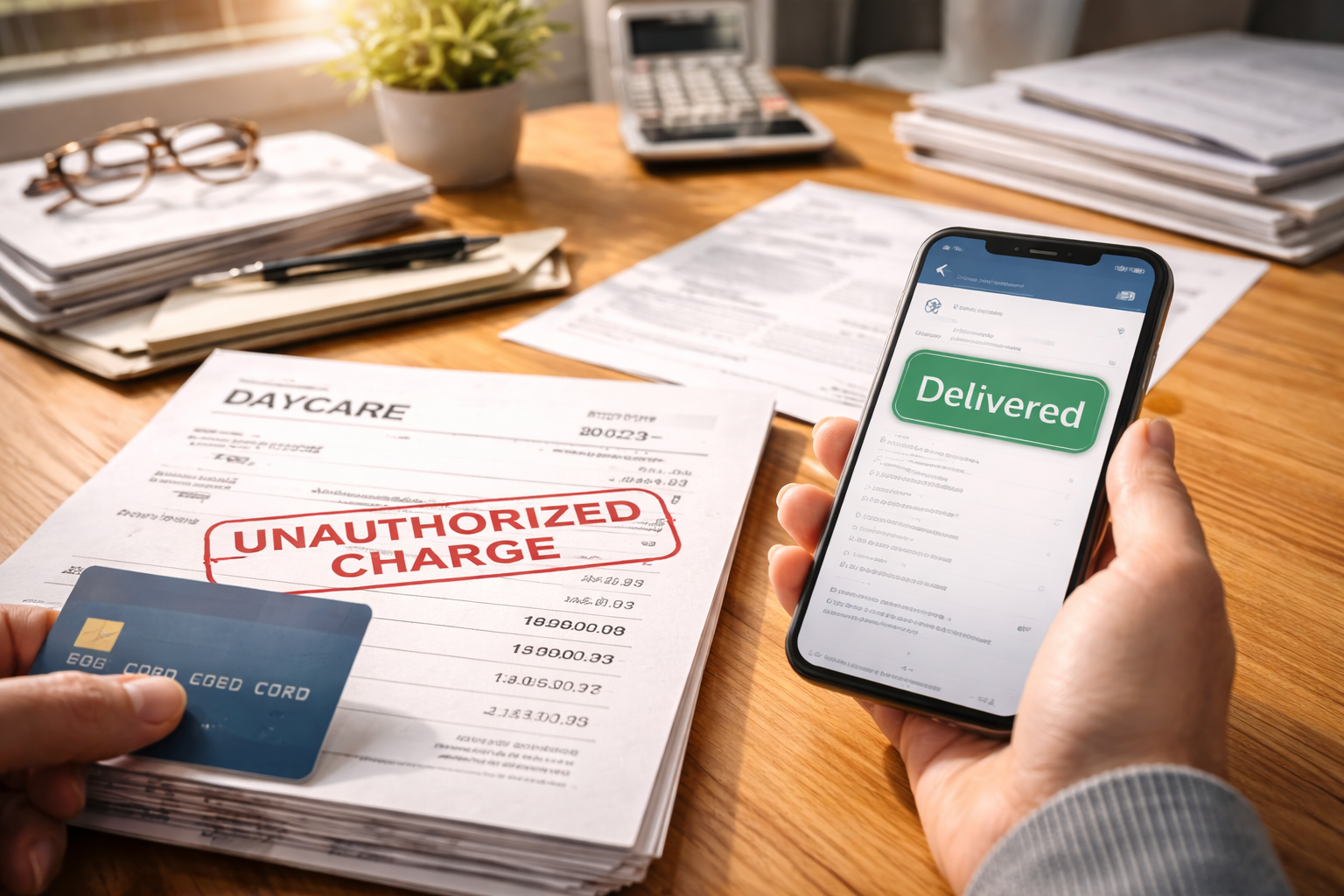
Daycare unauthorized charge. I noticed it the same way most parents do—by accident. I wasn’t reviewing statements line by line. I was checking my balance, half-distracted, when a charge from the daycare jumped out. The amount didn’t match anything I remembered agreeing to.
At first, I assumed I’d forgotten something. A late pickup? A new fee? But the more I checked, the clearer it became: this wasn’t confusion—it was a charge I never authorized. That moment matters, because what you do next determines whether this gets quietly fixed or quietly repeated.
If you want to quickly compare this situation with other common daycare billing problems, this hub helps you orient yourself before taking action:
Why Unauthorized Charges Happen at Daycare Centers
Daycare unauthorized charge usually isn’t fraud in the criminal sense. It’s most often a breakdown between billing systems, outdated policies, or assumptions made without renewed consent. Automatic billing setups are especially vulnerable when rates change, attendance shifts, or staff manually add fees.
Many parents don’t realize that “policy language” does not automatically equal authorization. If you didn’t explicitly agree to a charge—or weren’t properly notified—it may still be unauthorized even if the daycare believes it’s routine.
How Daycare Billing Offices See This Situation
From the daycare’s perspective, the charge may look justified: a fee code was applied, the system processed it, and the balance cleared. What they often miss is the consent gap. Billing staff may assume prior agreements still apply, especially if your child has been enrolled for a long time.
Daycare unauthorized charge disputes usually get resolved faster when you frame the issue as “authorization and notice,” not emotion or blame.
Your Rights as a Parent and Consumer
You have the right to clear disclosure, advance notice of new fees, and consent before charges are processed. In many states, childcare providers must document fee schedules and changes. An undocumented or surprise charge is not automatically valid.
You also have the right to dispute charges with your payment provider if the daycare cannot show authorization.
Case Branches: Identify Your Exact Unauthorized Charge
Case A: New fee appeared without written notice.
This includes supply fees, activity fees, or “administrative” charges added mid-cycle.
Action: Ask for the written notice and the date you agreed. If they can’t produce it, request reversal.
Case B: Rate increase applied without acknowledgment.
Some daycares update tuition but fail to obtain renewed consent.
Action: Ask when the rate change was communicated and how consent was recorded.
Case C: Autopay pulled a charge after schedule change.
If your child reduced days or hours, old billing rules may still apply.
Action: Request recalculation and refund for overbilled days.
Case D: Charge tied to a service you did not use.
Examples include meals, transportation, or enrichment programs.
Action: Ask for attendance or usage records supporting the charge.
Case E: Late fee triggered incorrectly.
Payments posted on time can still be flagged late due to processing delays.
Action: Provide proof of payment timestamp and request fee removal.
Case F: Duplicate or stacked fees.
A fee was applied twice or layered on top of tuition.
Action: Ask for an itemized ledger showing each line item.
Case G: Charge added after payment reversal or dispute.
Some centers respond to reversals by adding “penalty” fees.
Action: Confirm whether such fees are permitted under your agreement.
Case H: Enrollment status changed but billing didn’t.
Withdrawal notices don’t always reach billing systems.
Action: Show your withdrawal or change notice and request adjustment.
Case I: Charge posted while account access was restricted.
If services were paused but billing continued.
Action: Request refund for non-service period.
Case J: You cannot identify the charge at all.
No description, no reference, no explanation.
Action: Treat this as fully unauthorized and escalate immediately.
The Right Way to Fix a Daycare Unauthorized Charge
Daycare unauthorized charge issues resolve fastest when you follow a clean sequence:
Step 1: Gather proof (statements, invoices, emails).
Step 2: Request an itemized breakdown in writing.
Step 3: Ask where your authorization is documented.
Step 4: Set a response deadline (politely).
Step 5: Dispute with your payment provider if unresolved.
Keep all communication factual and documented.
If your unauthorized charge was actually a duplicate posting, this guide explains how those errors usually get corrected:
What Not to Do (Even If You’re Upset)
Do not stop payment without notice unless advised by your card issuer. Do not accuse staff personally. Do not assume policy language equals consent. Escalation works best when you control the narrative.
Official Consumer Protection Guidance
If the daycare cannot show that you authorized the charge, U.S. consumer protection rules allow you to dispute it directly with your card issuer.
This is not a threat step — it is a documented consumer right.
Recommended Next Reading
If this dispute affects your child’s enrollment or access, this explains what happens next and how to protect continuity of care:
FAQ
Is an unauthorized charge always illegal?
Not always illegal, but often refundable if consent or notice is missing.
Can the daycare retaliate?
They should not. Document everything and escalate calmly if access is threatened.
Should I dispute with my card company immediately?
Try resolving with the daycare first unless the charge is clearly fraudulent.
Key Takeaways
You are not overreacting when you question a charge you never approved.
Daycare unauthorized charge situations are about documentation, consent, and follow-through—not confrontation.
If you see an unfamiliar daycare charge today, your next action is clear: request an itemized explanation in writing, ask where your authorization exists, and set a timeline for correction. If that fails, protect yourself through a formal dispute. That sequence stops repeat charges and gets refunds faster.