
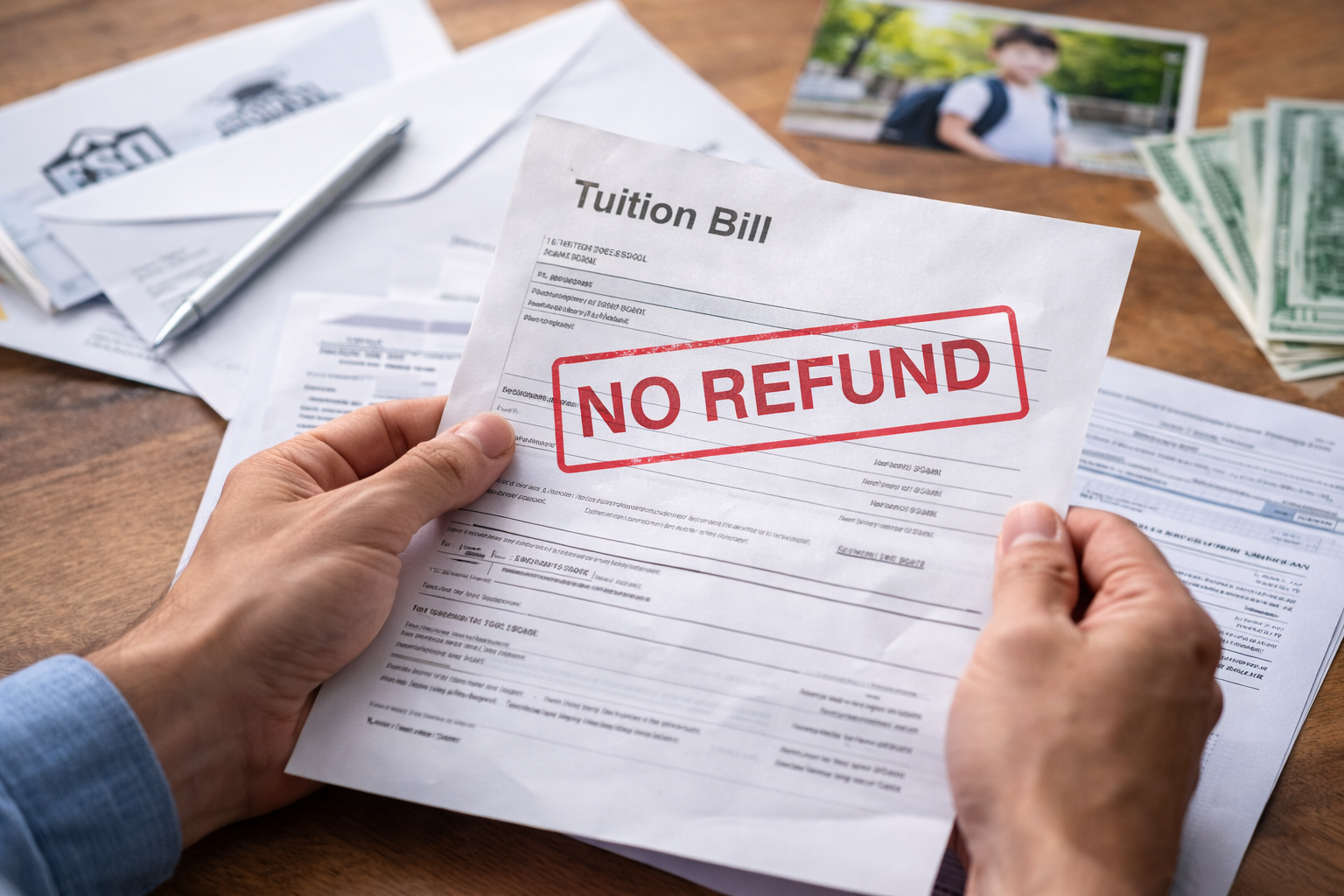
Private School Refused Tuition Refund After Student Withdrawal. That was the moment the situation changed from stressful to serious. The withdrawal had already been submitted, the child was no longer attending, and the expectation was simple: the account would be adjusted, and at least part of the tuition would come back. Instead, the billing portal still showed the same full balance, and the message from the school was even worse than the number. The school was not saying the refund was delayed. It was saying there would be no refund at all.
Private School Refused Tuition Refund After Student Withdrawal is the kind of dispute that catches families off guard because it feels like a common-sense issue at first. If the student is no longer there, parents expect the tuition charge to shrink. But private schools in the U.S. often treat withdrawal, tuition, and refund rights as contract issues, not fairness issues. That means the most important question is not whether the student left, but what the signed tuition agreement allowed the school to do after the student left.
If you want the broader system behind school billing problems before dealing with this refund dispute, start with the main billing guide below. It helps explain how tuition charges, adjustments, and account decisions move through school billing workflows.
Why private schools deny tuition refunds after withdrawal
Private School Refused Tuition Refund After Student Withdrawal disputes usually begin with one hard reality: private schools rely on enrollment contracts to stabilize revenue. Unlike public schools, many private schools budget staffing, classroom space, and operating expenses around committed tuition income. Once a family signs the enrollment agreement, the school often treats that commitment as binding for a term, semester, or full academic year.
This is why a family can withdraw a student and still be told that tuition remains owed. The school may not view the account as a pay-for-attendance arrangement. It may view the account as a contractual payment obligation triggered by enrollment, seat reservation, and the school’s reliance on that reserved seat.
In practice, Private School Refused Tuition Refund After Student Withdrawal often comes from one of these policy models:
- full tuition remains owed after a stated withdrawal deadline
- only a partial refund is available before classes begin
- no refund applies once the term starts
- annual tuition is earned in installments but committed in full
- tuition insurance is the only approved refund mechanism after a certain date
That is why this kind of dispute has to be handled as both a billing issue and a contract interpretation issue.
What the school is usually relying on internally
Private School Refused Tuition Refund After Student Withdrawal usually does not come from a single person making a random decision. It often comes from a chain of internal records that reinforce each other. The admissions office has the signed enrollment agreement. The business office has the tuition schedule. The student information system has the withdrawal date. The billing ledger has the posted charges. If all of those records line up in the school’s favor, the refusal may appear automatic from the parent’s point of view.
Most schools evaluate the dispute through a few internal checkpoints:
- what date the contract was signed
- whether the contract included a stated withdrawal deadline
- whether the student actually began the term
- whether a written withdrawal notice was received
- whether any exceptions apply under the school’s handbook or business office policy
That means the family’s strongest argument usually comes from documentation, not emotion. If the date in the school’s system is wrong, or if the school applied the wrong refund rule, that can change the outcome. If the records are complete and the contract language is clear, the dispute becomes harder but not always impossible.
The most common refund-denial branches
Private School Refused Tuition Refund After Student Withdrawal is not one uniform problem. It breaks into several different branches, and each branch needs a different response.
Branch 1 – The withdrawal happened after the refund deadlineThis is the most common version. The school points to a date in the contract and says that once that date passed, the tuition became non-refundable. In this branch, the key question is whether the school used the correct deadline language and whether the family received the exact policy incorporated into the contract.
Branch 2 – The school says the full year was contractually committed
Some private schools structure tuition as an annual obligation even when payments are made monthly or in installments. Families often assume monthly billing means monthly obligation. The school may argue the opposite. In this branch, the contract wording around “annual tuition obligation” matters more than the payment schedule.
Branch 3 – The withdrawal was submitted, but the school recorded it later
This branch is more favorable to the family. The parent may have emailed or submitted withdrawal paperwork before the refund cutoff, but the school recorded the withdrawal later in its system. Here the fight is not over policy. It is over the official date that should control the refund decision.
Branch 4 – The school promised flexibility verbally, but denied it later
Admissions staff or administrators sometimes say things informally that sound reassuring during a stressful withdrawal. Later, the business office enforces the written contract anyway. In this branch, the family needs to determine whether the promise was documented clearly enough to challenge the formal billing outcome.
Branch 5 – The school is not denying the refund in theory, but has not processed it
This is different from a true refusal. The school may claim the refund is pending, under review, or awaiting finance approval. In that situation the issue may be processing delay rather than policy denial, and the response should focus on account status, calculation, and timing.
Branch 6 – The school says tuition insurance was required
Some schools rely heavily on tuition refund insurance programs. If the family declined coverage, the school may point to that choice and say no refund pathway remains. In this branch, you need to confirm whether the contract truly made insurance the exclusive recovery path or merely one optional path.
When the problem is policy and when it is system error
Private School Refused Tuition Refund After Student Withdrawal can look identical on the surface whether the school is enforcing policy correctly or the billing office simply failed to process the account. The portal may show the same balance in both situations. That is why families need to separate policy denial from ledger failure.
Signs of a true policy denial include:
- a written explanation citing the tuition contract
- reference to a withdrawal deadline or annual commitment clause
- a business office statement that no refund applies under school policy
- a refusal that is consistent across admissions, finance, and administration
Signs of a processing or ledger problem include:
- the school says the withdrawal was accepted but the account did not change
- different departments give different answers
- the school mentions a pending recalculation instead of a firm denial
- the balance appears unchanged even though part of the tuition should have been reversed under the policy
If the issue looks more like delay than refusal, this related article may be the closest supporting read because it focuses on refund processing after a student leaves.
The records that decide who wins
Private School Refused Tuition Refund After Student Withdrawal cases usually turn on a small set of documents. Families often focus on the emotional fairness of the situation, but the school will usually focus on paperwork, dates, and formal notice requirements.
The most important documents are usually:
- the signed enrollment or tuition contract
- the parent handbook if incorporated into the contract
- written withdrawal notice and timestamp
- emails with admissions, administration, or the business office
- the student ledger showing charges, payments, and any credits
- tuition insurance election records, if any
If you cannot line up the contract, the withdrawal date, and the school’s ledger, you are arguing in the dark.
Parents should also compare the amount being withheld with the actual contract language. Some schools refuse the entire refund when the contract only allows them to retain a deposit or a stated portion of tuition. That is where an itemized explanation becomes critical.
What families should ask the school right now
Private School Refused Tuition Refund After Student Withdrawal disputes move faster when the family asks narrow, document-based questions rather than broad fairness questions.
- What exact contract section is the school relying on to deny the refund?
- What withdrawal date is recorded in the student system?
- Was the account reviewed as a policy denial or a pending processing issue?
- How was the refund amount calculated, if any partial credit was considered?
- Does the school view the tuition as a semester obligation or a full-year obligation?
- Was tuition insurance considered, and if so, on what basis?
- Can the school provide an itemized ledger showing all posted charges and adjustments?
These questions force the school to move from vague refusal language to a concrete position that can actually be tested against the paperwork.
Mistakes that hurt refund disputes
Families dealing with Private School Refused Tuition Refund After Student Withdrawal often make the dispute harder without realizing it.
- assuming withdrawal automatically voids the contract
- relying on a verbal promise with no written confirmation
- failing to preserve the first written withdrawal notice
- arguing fairness without citing the signed agreement
- waiting until the account moves toward collection status before responding
- accepting a vague denial without asking for the actual contract basis
One of the biggest mistakes is treating monthly tuition payments as proof that only one month at a time was owed. Many private schools bill monthly for convenience while legally treating the obligation as annual. That misunderstanding alone drives a large share of these disputes.
How to challenge the refusal effectively
Private School Refused Tuition Refund After Student Withdrawal does not always end with the first no. A structured challenge is often stronger than a heated one. The goal is to make the school defend its position against the actual records.
A strong challenge usually includes:
- the date the withdrawal was submitted
- the exact contract language the parent believes applies
- the reason the school’s calculation appears wrong or incomplete
- a request for the itemized ledger and written refund determination
- a clear deadline for written response from the business office
If the school’s position appears shaky, this is sometimes enough to trigger internal review. If the school’s position is firm but the family still needs time or relief, the next practical issue may become preventing escalation of the balance.
What happens if the school keeps the balance on the account
Once Private School Refused Tuition Refund After Student Withdrawal turns into an unpaid balance, the dispute can expand beyond the refund itself. The school may place an internal hold, stop re-enrollment, delay records, or eventually move the balance toward collections depending on the school’s policies.
That is why families should not treat the refund dispute as separate from account risk. If the school is holding the line on the refund, the next move may be to appeal the tuition charge before the account gets more serious.
Private school context matters here
This article is specifically about a private school tuition dispute, not a public school issue and not a college refund governed by a standard institutional refund table. Private School Refused Tuition Refund After Student Withdrawal cases are shaped heavily by private enrollment contracts, parent handbooks, and school-specific policies. That is exactly why two families can withdraw students under similar real-world circumstances and still receive completely different billing outcomes.
One school may allow a prorated refund up to a specific week. Another may keep the entire semester tuition once classes begin. Another may excuse part of the balance only after administrative review. The private school category matters because the contract often controls more than parents expect.
Official outside reference
For official background information about private and nonpublic schools in the United States, the U.S. Department of Education provides an overview of how private schools operate within the national education system.
U.S. Department of Education – Non-Public Education Overview
Key Takeaways
- Private School Refused Tuition Refund After Student Withdrawal is usually driven by contract language, withdrawal dates, and internal billing records.
- The main issue is often not whether the student left, but whether the contract still made tuition owed after that date.
- Families need the signed contract, written withdrawal notice, and itemized ledger before arguing the dispute.
- Some cases are true policy denials, while others are really refund-processing or date-recording problems.
- If the school keeps the balance active, the dispute can quickly become a broader account-risk problem.
FAQ
Can a private school refuse a tuition refund after a student withdraws?
Yes. Many private schools rely on signed tuition contracts that limit or eliminate refunds after certain deadlines.
Does monthly payment mean monthly obligation?
Not necessarily. In many Private School Refused Tuition Refund After Student Withdrawal disputes, the school treats monthly billing as an installment plan for a larger annual commitment.
What should parents review first?
The signed enrollment or tuition contract, the recorded withdrawal date, and the school ledger showing how the account was handled.
What if the school accepted the withdrawal but never changed the balance?
That may indicate a processing problem rather than a true refund denial. In that situation, the account needs a formal recalculation review.
Can parents still challenge the refusal?
Yes. A documented challenge focused on contract language, timing, and calculation is often more effective than a general complaint about fairness.
What to do now
Private School Refused Tuition Refund After Student Withdrawal is serious because it can quietly turn from a refund disagreement into an enforceable balance dispute if the family waits too long. The school may already have a contract section in mind, a withdrawal date in its system, and a fixed ledger position. You need to know exactly what those are before the account hardens further.
Pull the signed tuition contract today, locate the first written withdrawal notice, ask the school for the exact clause it is relying on, and request an itemized ledger showing why the refund was denied. If the date, policy, or calculation is wrong, challenge it immediately in writing. Do that now, before the school treats the denied refund as a settled balance and moves the account into a harder stage.